Skip to the content
Rainfall measurement plays a central role in environmental monitoring, infrastructure planning, and operational decision-making. Even small measurement errors can influence irrigation schedules, flood prediction models, stormwater management systems, and hydrological research.
Organizations relying on precipitation data often face a practical challenge. They fail to buy rain gauges that provide consistent, reliable readings over long periods. Rainfall instruments vary in measurement method, sensitivity, and durability. Choosing the right solution requires understanding both technical specifications and the conditions in which the instrument will operate.
Accurate rainfall measurement supports dependable environmental data and strengthens confidence in long-term monitoring programs.
What makes a rain gauge accurate?
Accuracy depends on proper calibration, high measurement resolution, and correct installation in an unobstructed location.
Where should a rain gauge be installed for best results?
A rain gauge should be installed on level ground in an open area away from buildings, trees, or structures that may block rainfall.
Why Precision in Rainfall Measurement Matters
Precipitation data influences several operational and environmental decisions. Inconsistent rainfall measurements can lead to flawed modeling, inefficient resource planning, or incorrect weather analysis.
Reliable rainfall monitoring supports:
- Flood risk assessment and stormwater planning
- Agricultural irrigation scheduling
- Climate and hydrological research
- Infrastructure design and water resource management
- Environmental compliance reporting
A proper rain gauge provides dependable ground-level precipitation data. This information helps organizations maintain accurate weather records and improve the reliability of forecasts.
Understanding the Main Types of Rain Gauges
Rain gauges measure precipitation through different mechanisms. Each method has advantages depending on the monitoring objective.
1. Tipping Bucket Rain Gauge
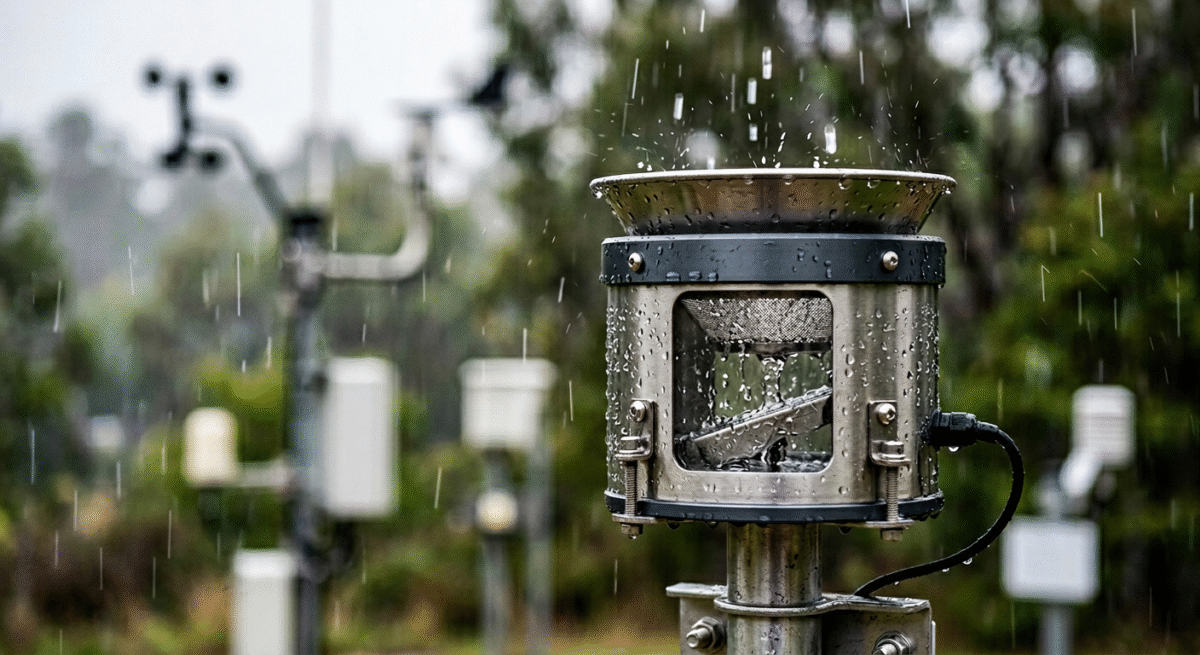
A tipping-bucket rain gauge collects rainfall by tipping a small bucket after it reaches a preset volume.
Key characteristics include:
- Records rainfall as incremental pulses
- Suitable for automated weather monitoring systems
- Provides reliable long-term precipitation tracking
Environmental monitoring networks frequently use this type.
2. Weighing Rain Gauge
A weighing rain gauge measures precipitation by continuously recording the weight of collected water.
Important features include:
- High measurement precision
- Ability to capture varying rainfall intensity
- Accurate monitoring during prolonged precipitation events
This type is commonly used in research environments.
3. Optical Rain Gauge
An optical rain gauge uses a light beam to detect rainfall drops passing through the sensing area.
Advantages include:
- Real-time rainfall detection
- No mechanical moving parts
- Minimal maintenance requirements
Optical systems are useful where maintenance access may be limited.
Key Specifications to Evaluate Before Choosing
When organizations buy rain gauges, reviewing technical specifications improves performance and reliability.
Important factors include:
- Resolution: The smallest rainfall increment the instrument can detect
- Accuracy Tolerance: Determines how close the measurement is to the true rainfall amount
- Data Output Compatibility: Pulse, analog, or digital communication formats
- Environmental Durability: Resistance to temperature extremes, debris, and UV exposure
- Maintenance Requirements: Frequency of cleaning, calibration, or inspection
A rain gauge that aligns with both measurement needs and environmental conditions improves long-term data quality.
Matching Rain Gauge Type to Application
Different monitoring objectives require different approaches to rainfall measurement. Matching the instrument to the application improves both accuracy and reliability.
Typical use cases include:
Infrastructure Monitoring
- Stormwater management systems
- Urban drainage monitoring
- Flood mitigation planning
Agricultural Operations
- Irrigation scheduling
- Crop water requirement tracking
- Soil moisture correlation
Environmental Research
- Long-term climate observation
- Hydrological modeling
- Watershed monitoring programs
Each application benefits from rainfall instruments that balance accuracy, durability, and data-integration capabilities.
Installation and Placement Considerations That Affect Accuracy
Even a well-designed rain gauge can produce inaccurate readings if installed incorrectly. Proper placement ensures the instrument measures precipitation without interference.
Common installation guidelines include:
- Positioning the gauge on level ground
- Keeping the instrument away from tall structures or trees
- Mounting at a standard height above ground level
- Ensuring unobstructed exposure to rainfall
Wind patterns, nearby obstacles, and surface reflections can influence rainfall capture. Careful installation improves measurement consistency over time.
Common Mistakes When Selecting a Rain Gauge
Organizations sometimes overlook key factors when evaluating rain measurement instruments. These oversights can reduce measurement reliability.
Frequent selection mistakes include:
- Choosing equipment without considering long-term environmental conditions
- Ignoring data integration requirements with monitoring systems
- Selecting instruments with insufficient measurement resolution
- Overlooking maintenance accessibility
- Installing gauges in locations that block rainfall capture
Evaluating both instrument specifications and site conditions helps avoid these problems.
Also Read:
Importance of Accurate Precipitation Measurement
How Do Meteorologists Utilize Data from Precipitation Sensors in Forecasting?
How Rain Gauges and Radar Work Together to Deliver More Reliable Rainfall Data
Building Confidence in Long-Term Weather Monitoring
Reliable rainfall data underpin many environmental monitoring programs. Accurate measurements support better forecasting models, improved water management strategies, and more dependable research outcomes.
Selecting the right rain gauge requires careful consideration of measurement technology, environmental conditions, and installation practices. When these elements align, precipitation monitoring becomes significantly more dependable.
Organizations seeking consistent rainfall measurements can contact Comptus to review and buy rain gauges online and support long-term weather monitoring needs.