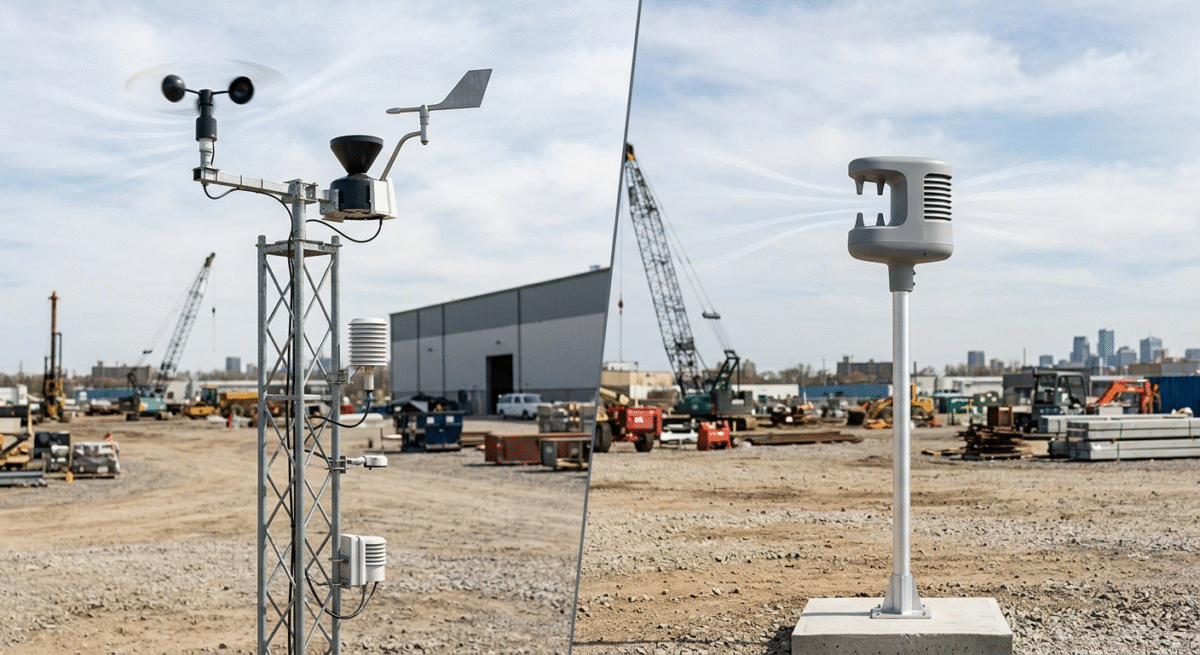
Accurate weather measurement supports safe operations, environmental monitoring, and infrastructure planning. Many industries depend on reliable readings for wind speed, rainfall, air temperature, humidity, and atmospheric pressure. Weather stations collect this data continuously, enabling organizations to make informed operational decisions.
Two common approaches dominate modern monitoring systems: traditional automatic weather stations and ultrasonic weather stations. Both systems gather atmospheric data, yet they rely on different sensing technologies and maintenance approaches. Understanding these differences helps select a weather monitoring system that aligns with site conditions, accuracy requirements, and operational priorities.
What Defines a Traditional Automatic Weather Station?
A traditional automatic weather station uses multiple mechanical and electronic sensors to collect environmental data. Each sensor measures a specific parameter, and the station combines the results into a single monitoring system.
Typical components include:
- Cup or propeller anemometers for wind speed
- Wind vanes for wind direction
- Rain gauges for precipitation measurement
- Temperature and humidity sensors
- Barometric pressure sensors
- Data loggers for recording measurements
Many traditional automatic weather stations rely on moving components to measure wind and rainfall. These parts respond to environmental forces such as airflow or falling precipitation.
This design has served weather monitoring systems for decades. It provides dependable measurements across many installations. However, moving components require periodic inspection, calibration, or replacement to maintain accuracy.
What Is an Ultrasonic Weather Station?
An ultrasonic weather station measures wind speed and direction using acoustic signals rather than mechanical movement. The system sends ultrasonic pulses between transducers. By measuring the travel time of these sound waves, the instrument calculates wind velocity and direction with high precision.
Key characteristics of ultrasonic systems include:
- No moving mechanical parts
- Rapid measurement intervals
- Reduced maintenance requirements
- Compact sensor design
- Stable performance in varied environmental conditions
Ultrasonic weather stations rely on electronic signal processing instead of rotating components. This helps deliver consistent readings with minimal mechanical wear.
Side-by-Side Comparison: Key Differences
A direct comparison highlights the differences between the two weather station technologies.
Traditional Automatic Weather Stations
- Use rotating or moving components for wind measurement
- May require periodic mechanical maintenance
- Long history of field deployment
- Sensors are often installed as separate components
Ultrasonic Weather Stations
- Measure wind using acoustic signals
- Contain no moving mechanical parts
- Require less mechanical servicing
- Often integrate multiple sensors into a compact design
Both technologies support environmental monitoring, but the sensing method influences reliability, maintenance, and long-term performance.
Accuracy and Data Integrity Considerations
Accuracy depends on sensor design, calibration, and environmental conditions.
Traditional anemometers measure wind through physical rotation. Under steady airflow, these sensors provide reliable measurements. However, mechanical friction or component wear may gradually influence readings.
Ultrasonic sensors measure wind by detecting changes in the travel time of sound waves. Because this process relies on electronic calculations rather than mechanical rotation, it reduces the risk of mechanical drift.
Data integrity also depends on sampling speed. Ultrasonic systems often capture rapid wind fluctuations more effectively due to faster measurement intervals. This capability can be valuable in applications where wind conditions change quickly.
Environmental and Site Conditions That Influence System Choice
Site conditions often determine which weather station technology performs best.
Factors that influence system selection include:
- Exposure to dust, ice, or debris
- Long-term maintenance accessibility
- Wind turbulence at the deployment site
- Temperature extremes
- Data resolution requirements
Mechanical sensors may experience additional wear in harsh environments. In remote installations, maintenance access may also become difficult. Ultrasonic wind sensors and weather station systems have fewer moving parts and may provide operational advantages in these conditions.
When a Traditional Automatic System Makes Practical Sense
Traditional automatic weather stations remain practical in many monitoring environments. These systems may be appropriate when:
- A facility already operates mechanical weather sensors
- Existing infrastructure supports traditional sensor networks
- Measurement requirements remain relatively stable
- Maintenance access is readily available
Many monitoring programs continue using these systems because they are widely understood and compatible with established meteorological equipment.
When an Ultrasonic Weather Station Is the Smarter Investment
Ultrasonic weather stations often provide advantages when reliability and maintenance efficiency are priorities. Organizations may favor ultrasonic systems when:
- Remote locations limit maintenance visits
- High-resolution wind data is required
- Long-term monitoring programs need stable accuracy
- Mechanical wear could affect system performance
By eliminating rotating components, these stations reduce mechanical stress and simplify long-term operation.
Also Read:
How to Read a Wind Vane for Precision Weather Monitoring
How to Tailor Barometric Pressure Sensors for Industrial Applications
Understanding the Most Important Weather Measuring Instruments in Use Today
How to Evaluate Weather Station Specifications Before Purchase
Both traditional automatic weather stations and ultrasonic weather stations support reliable environmental monitoring. Each system offers advantages depending on installation requirements, maintenance access, and measurement objectives.
Traditional systems provide a familiar approach built on long-established sensor technologies. Ultrasonic weather stations offer a modern alternative that reduces mechanical wear while capturing detailed wind measurements.
Selecting a weather station involves reviewing several technical factors. Important specifications include:
- Wind measurement range and accuracy
- Sampling frequency and response time
- Environmental operating limits
- Sensor integration capability
- Data communication interfaces
- Maintenance and calibration requirements
Careful evaluation of these specifications ensures the weather monitoring system aligns with operational goals and environmental conditions.
Organizations that need weather station ultrasonic wind sensor systems can contact Comptus to better understand how this technology supports long-term data reliability.